About Me
Research Interests: 3D understanding; Neural network in Graphics
Email: xiangyu.wang@visus.uni-stuttgart.de
Education:
- Dec. 2024–Now PhD student at VISUS, Universität Stuttgart, Germany, research with Prof. Dr. Dieter Schmalstieg
- Sep. 2021–Mar. 2024 Research master at College of Control Science and Engineering, Zhejiang University, research with Prof. Dr. Qi Ye and Prof. Dr. Jiming Chen
- Sep. 2017–Jun. 2021 Bachelor at College of Control Science and Engineering, Zhejiang University; Chu Kochen Honors College
Also known as: Zotero developer, active open-source contributor windingwind.

Publications
-
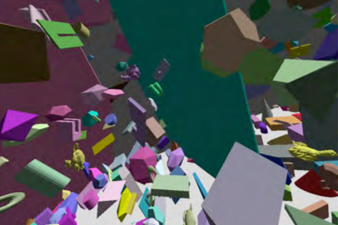
NeuralPVS: Learned Estimation of Potentially Visible Sets
ACM SIGGRAPH Asia 2025
[project page] [paper] [arxiv] [pdf] [code (training)] [code (rendering)] [video]
Abstract
Real-time visibility determination in expansive or dynamically changing environments has long posed a significant challenge in computer graphics. Existing techniques are computationally expensive and often applied as a precomputation step on a static scene. We present NeuralPVS, the first deep-learning approach for visibility computation that efficiently determines from-region visibility in a large scene, running at approximately 100 Hz processing with less than 1% missing geometry. This approach is possible by using a neural network operating on a voxelized representation of the scene. The network's performance is achieved by combining sparse convolution with a 3D volume-preserving interleaving for data compression. Moreover, we introduce a novel repulsive visibility loss that can effectively guide the network to converge to the correct data distribution. This loss provides enhanced robustness and generalization to unseen scenes. Our results demonstrate that NeuralPVS outperforms existing methods in terms of both accuracy and efficiency, making it a promising solution for real-time visibility computation.
Comments: SIGGRAPH Asia 2025
Subjects: Graphics (cs.GR)
ACM classes: I.3.7
Cite as: arXiv:2509.24677 [cs.GR] (or arXiv:2509.24677v1 [cs.GR] for this version) -
-
AF
-
TWR
Towards weather-robust 3D human body reconstruction: Millimeter-wave radar-based dataset, benchmark, and multi-modal fusion
IEEE Transactions on Circuits and Systems for Video Technology 2024
-
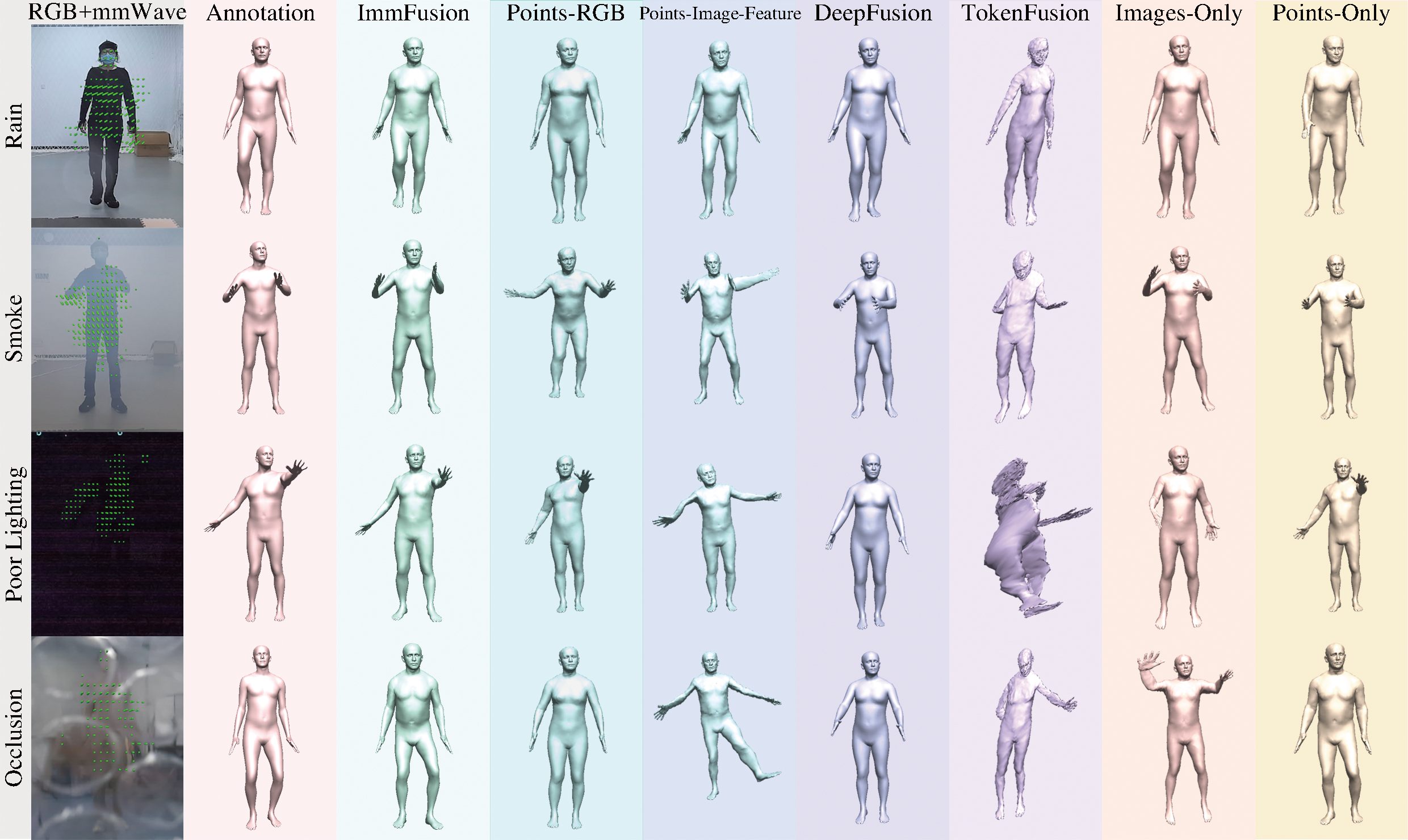
ImmFusion: Robust mmWave-RGB Fusion for 3D Human Body Reconstruction in All Weather Conditions
ICRA 2023
-

mmBody Benchmark: 3D Body Reconstruction Dataset and Analysis for Millimeter Wave Radar
ACM MM 2022
Blog
Rebuilding this site
The homepage now runs on Vite with markdown content.